Sequential vs. Indexed Sequential File Organization: What Is the Difference?
When computer scientists talk about file organization, they are asking one deceptively simple question: in what order do you store records, and how do you find them again? The answer has profound effects on read speed, write efficiency, and the cost of maintaining your data over time.
Two of the most foundational approaches are sequential file organization and indexed sequential file organization (ISAM). Both deal with ordered data, but they retrieve it in fundamentally different ways. Understanding the distinction matters whether you are studying database theory, architecting a storage system, or simply trying to understand how digital asset management platforms organize and surface files efficiently.
What Is Sequential File Organization?
Sequential file organization stores records one after another in a fixed order, typically sorted by a key field such as an ID, date, or name. To find a specific record, the system reads through the file from the beginning until it reaches the target.
Think of it like a cassette tape. To get to track seven, you have to fast-forward past tracks one through six. There is no shortcut. The file is linear, and so is the access pattern.
Characteristics of sequential organization
- Records are stored in a defined sort order (ascending or descending by key)
- Access is strictly linear: reading record N requires passing records 1 through N-1
- Inserts and deletions are expensive: adding a record mid-file requires rewriting everything after it
- Works well for batch processing: payroll runs, end-of-day reports, full file scans
- Minimal storage overhead: no indexes or pointers required
Sequential files shine when you need to process every record in order -- a bank printing monthly statements, a logistics system reconciling overnight shipments. They struggle when you need random access: fetching one record from a million-row file means scanning up to a million entries.
What Is Indexed Sequential File Organization?
Indexed sequential file organization (ISAM) was designed to solve exactly that problem. It keeps the same sorted, sequential layout on disk but adds an index: a separate structure that maps key values to physical disk locations.
The result is a system that supports both sequential access (scan the file in order) and direct access (jump straight to a record by looking up its key in the index). It is the best of both worlds -- with some tradeoffs.
How the index works
A basic ISAM index is a sorted list of key-location pairs. To find a record, the system searches the index (much faster than scanning the data file), retrieves the disk address, and jumps directly to that location. Most implementations use a multi-level index: a master index points to cylinder indexes, which point to track indexes, which point to individual records.
Characteristics of indexed sequential organization
- Retains the sorted, sequential data layout for efficient full-file scans
- Adds an index structure for fast random access by key
- Supports both sequential processing and direct record lookups
- Requires additional storage for the index
- Overflow areas handle inserts without immediate file reorganization
- Periodic reorganization is needed as overflow areas fill up over time
Sequential vs. Indexed Sequential: The Core Differences
Here is a direct comparison across the dimensions that matter most:
Access method: Sequential reads records in order from the start. Indexed sequential uses an index to jump directly to any record by key.
Speed for random access: Sequential is slow (O(n) scan). Indexed sequential is fast (O(log n) index lookup + direct read).
Speed for sequential scans: Both are efficient. Indexed sequential can scan the data file just like a pure sequential file.
Insert cost: Sequential requires shifting records and rewriting the file. Indexed sequential uses overflow areas to defer reorganization.
Storage overhead: Sequential has no overhead beyond the data. Indexed sequential requires additional space for the index and overflow areas.
Complexity: Sequential is simple to implement and maintain. Indexed sequential requires index management and periodic reorganization.
Best for: Sequential is ideal for batch processing. Indexed sequential suits mixed workloads with both batch and interactive queries.
A Practical Example
Suppose you manage an employee database with 500,000 records, sorted by employee ID.
With sequential organization, printing all employees in ID order is fast and efficient. But if HR asks for employee 384,271, the system must read up to 384,271 records to find it. On a large file, that could take seconds.
With indexed sequential organization, the same query triggers an index lookup. The system checks the master index, narrows to a cylinder index, finds the track, and reads directly -- typically in milliseconds, regardless of file size.
But when 5,000 new hires join on the same day, sequential organization requires inserting records in sorted order and potentially rewriting large sections of the file. Indexed sequential handles this more gracefully by writing new records to an overflow area and updating the index, deferring the expensive sort until a scheduled reorganization.
When to Use Each Approach
Choose sequential organization when:
- Your workload is dominated by full-file scans or batch processing
- Random access is rare or unnecessary
- Storage overhead must be minimized
- Simplicity of implementation matters more than query performance
- Data is largely static and inserts are infrequent
Choose indexed sequential organization when:
- You need both batch processing and interactive queries on the same dataset
- Random access by key is a frequent operation
- The dataset is large and scanning the entire file is prohibitively slow
- You can afford the storage overhead for indexes and overflow areas
- Periodic reorganization is operationally acceptable
Beyond ISAM: How Modern Systems Evolved
ISAM was the dominant file organization method for much of the 1960s through the 1980s. IBM's original ISAM implementation was widely adopted before being superseded by VSAM (Virtual Storage Access Method), which added dynamic indexing and better overflow handling.
Today, relational databases use B-tree indexes -- a generalization of the indexed sequential concept -- as their primary access mechanism. A B-tree index allows the same fast lookups that ISAM pioneered, with more efficient insert handling and no need for periodic reorganization.
The underlying principle is identical: keep data in a sorted structure and maintain a separate index for fast key lookups. The implementation has evolved, but the concept that ISAM introduced is still at the heart of every major database engine in use today.
File Organization in the Context of Digital Asset Management
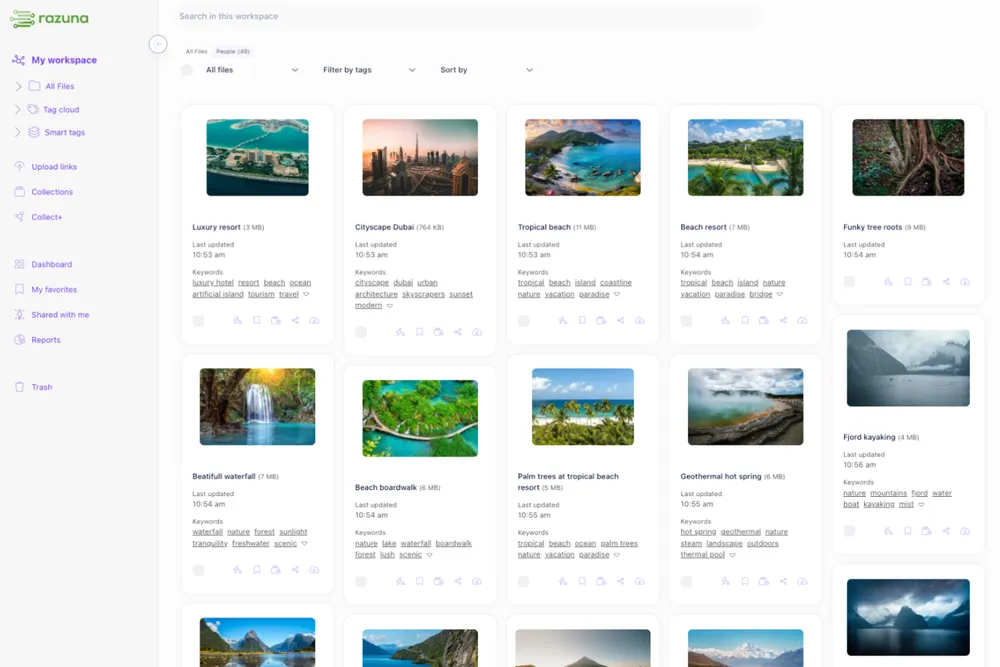
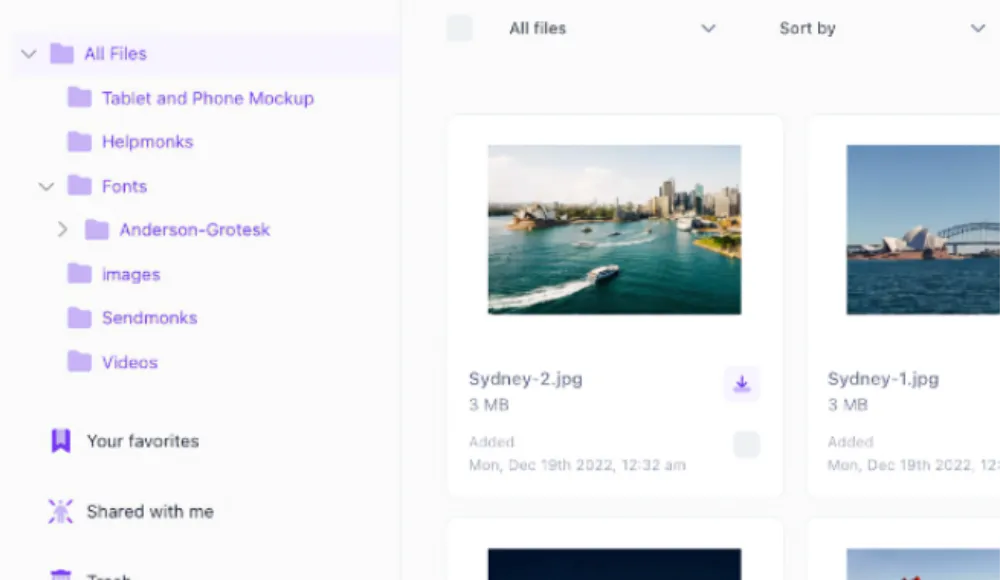
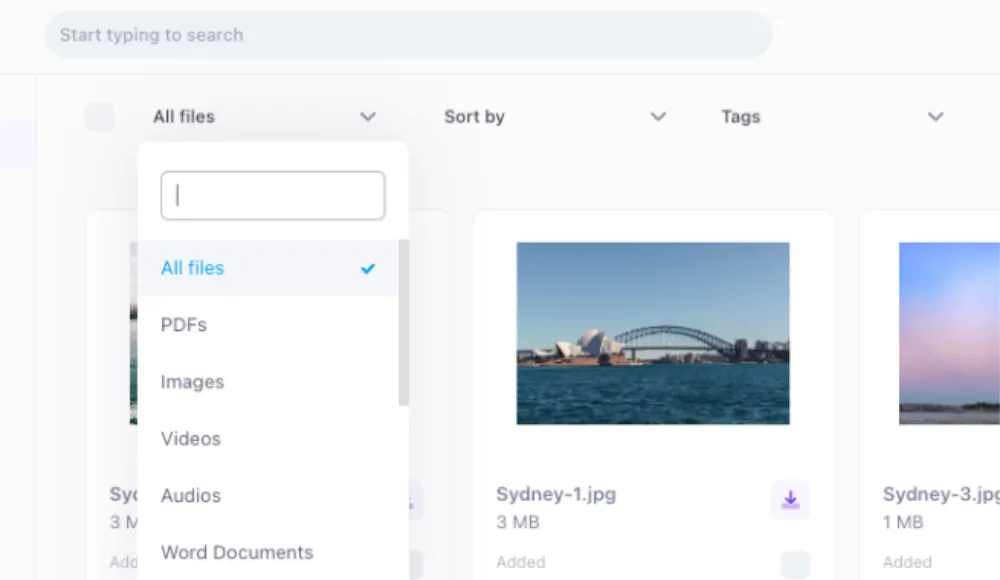
When teams think about file organization for their digital assets, the same tradeoffs apply. A flat folder structure with no indexing is essentially sequential: you can browse through everything, but finding a specific asset requires manual scanning. A proper digital asset management (DAM) platform adds the equivalent of an indexed layer: metadata, tags, and full-text search let you jump directly to any asset by keyword, file type, date, project, or custom attribute.
The analogy holds further. Like ISAM overflow areas, folders and drives accumulate clutter over time and need periodic reorganization. A DAM handles this automatically: assets are tagged at ingestion, metadata is enforced by policy, and search indexes are updated in real time. You get the direct-access benefits of indexed sequential organization without the manual overhead.
If your team is still navigating deeply nested folders to find the right version of a logo, you are operating on sequential file organization principles. The upgrade path -- to indexed, searchable, metadata-driven file management -- is exactly what a DAM provides.
Key Takeaways
- Sequential file organization stores records in sorted order and reads them linearly. Fast for batch processing; slow for random access.
- Indexed sequential file organization adds an index on top of the same sorted layout, enabling fast direct access without sacrificing sequential scan capability.
- The choice between them depends on your workload: pure batch processing favors sequential; mixed workloads favor indexed sequential.
- Modern databases use B-tree indexes, which generalize the ISAM concept with better insert handling and no reorganization requirement.
- In the context of digital file management, the leap from folder hierarchies to a DAM mirrors the leap from sequential to indexed file organization: same data, far faster retrieval.
Understanding these foundational concepts helps you make better decisions about how you store, organize, and retrieve data -- whether you are designing a database schema, choosing a storage architecture, or evaluating how your team manages digital assets.
For practical ways to organize and find assets, see Metadata Debt in DAM: Why Marketing Teams Keep Losing Assets They Already Own.
Explore Razuna features to see how these practices fit your team’s workflow.