AEO for Marketing Teams: Why Your DAM Is the Missing Piece in AI Search

Your content team spent weeks on a whitepaper. It lives in your DAM, perfectly tagged, ready to share. But when a potential customer asks ChatGPT, "What is digital asset management?" or Perplexity, "Best DAM software for marketing teams," your brand is nowhere to be found in the answer.
That is the AEO gap. And it is costing marketing teams more than they realize.
Search has changed. More than half of Google queries now end without a click. AI assistants like ChatGPT, Claude, Perplexity, and Gemini are generating direct answers from web content. The teams that get cited are the ones whose content is structured for extraction, not just discovery. This is Answer Engine Optimization (AEO), and your DAM has a bigger role in it than most people think.
What Is Answer Engine Optimization?
Answer Engine Optimization (AEO) is the practice of structuring content so that AI-powered systems can extract it as a direct answer to a user query. Where traditional SEO targets ranking positions in a list of blue links, AEO targets the answer itself: the paragraph that gets read aloud by a voice assistant, the summary that appears in a Google AI Overview, or the citation that shows up in a ChatGPT response.
Generative Engine Optimization (GEO) is the related discipline focused specifically on getting cited by large language models. The goal is the same: make your content the source that AI systems trust and quote.
For marketing teams, this matters because AI search is becoming the first stop for vendor research. If a buyer is asking an AI assistant to compare DAM platforms or explain how brand portals work, you want your content in that answer, not your competitor's.
Where Your DAM Fits In
Most marketing teams treat their DAM as a storage and distribution tool. Files go in, files come out. But a well-structured DAM is also a content architecture system, and content architecture is exactly what answer engines need.
Here is the connection: AI systems do not just read your blog posts. They index every piece of publicly accessible, structured content your brand produces, including asset descriptions, product pages, help docs, and case studies. If those assets are tagged with consistent terminology, contain accurate metadata, and live on pages with clear heading hierarchies, they become extractable.
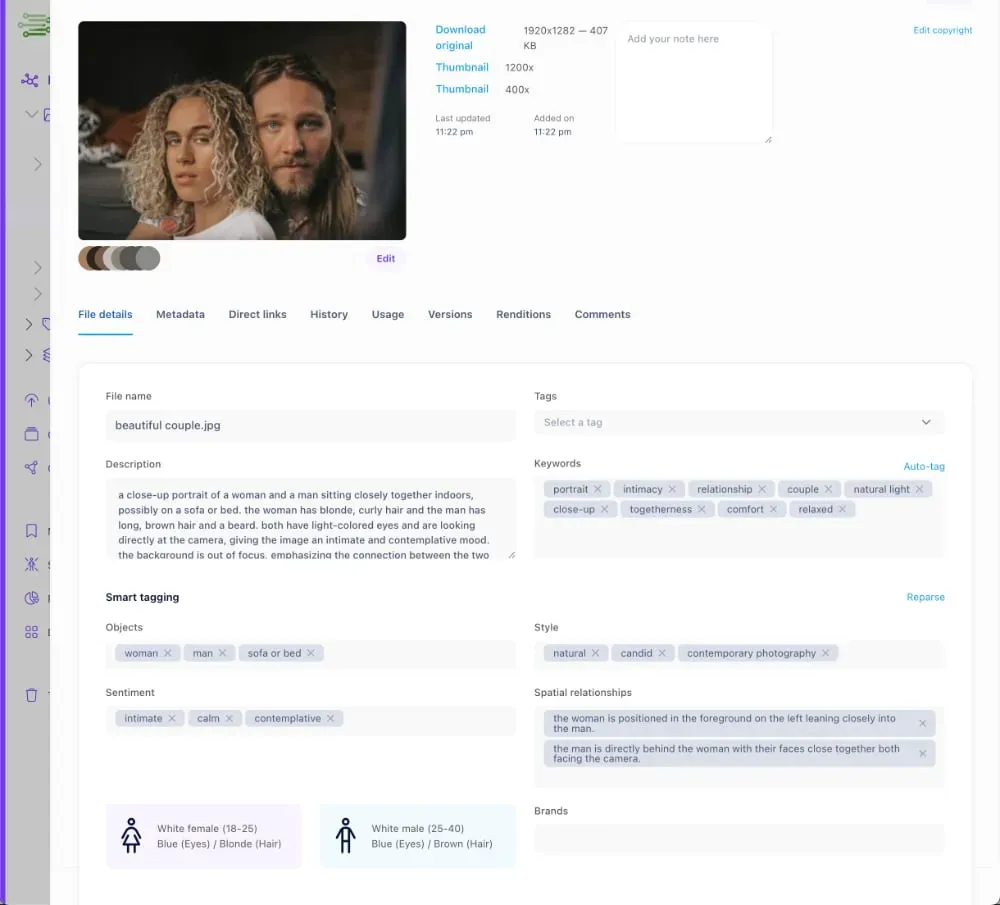
A DAM that enforces consistent metadata standards means every asset your team shares carries the same language. Your product photos use the same alt text conventions. Your brand guidelines use the same terms across every document. Your case studies follow the same structure. That consistency is not just good housekeeping; it is a GEO signal.
Razuna's metadata and tagging features are designed precisely for this: enforcing consistent naming, tagging, and description standards across every asset your team touches. That consistency compounds over time.
The Three AEO Wins a DAM Unlocks
1. Consistent brand language at scale
Answer engines learn your brand's vocabulary from the content you publish. If half your team calls it a 'brand portal' and the other half calls it a 'client hub,' the AI gets confused, and your content gets fragmented. A DAM with enforced terminology in asset names, folder structures, and descriptions trains your entire team to speak the same language, which in turn trains the AI.
This is not hypothetical. Perplexity and ChatGPT pull from public pages that reference your brand. If those pages are consistent, your brand description in AI answers is consistent. If they are not, you get contradictory summaries that erode trust.
2. Structured content that AI can extract
Most AI citations happen with content that follows a predictable structure: a clear question in a heading, a direct answer in the first sentence, and supporting evidence in the following paragraph. This is the definition block pattern, and it maps perfectly to how a good DAM documents its features.
Your features page should answer 'What is a brand portal?' in one sentence. Your help docs should answer 'How do I share assets with external reviewers?' in a numbered list. Your case studies should answer 'What results did [company type] get from using a DAM?' with specific numbers. Each of these is an AEO opportunity, and each can be seeded from the structured content you already manage in your DAM.
3. A single source of truth for content freshness
One factor AI systems use to decide whether to cite a source is whether it appears current and authoritative. Outdated content gets deprioritized. A DAM solves the freshness problem by making it easy to update assets without breaking links. When your team updates a product brief or refreshes a case study, the canonical URL stays the same. AI systems that previously indexed that page see an updated, current version of the document. A cloud storage folder full of v1, v2, and v2-FINAL versions tells AI exactly the opposite story.
Razuna handles version control automatically, so your published assets always point to the latest approved file. See how it works on the Razuna features page.
How to Structure Your DAM for AEO
This is the practical part. Here is what to actually do.
- Audit your public asset landing pages. Any page that houses a downloadable asset, case study, or brand guide should have a clear H1, a direct introductory paragraph that answers the implied question, and consistent terminology.
- Write asset descriptions that stand alone. Every asset in your DAM should have a description that makes sense on its own. 'Q1 2026 brand refresh logo pack, PNG and SVG formats, approved for all digital and print channels' is extractable. 'New logos' is not.
- Build a controlled vocabulary and enforce it. Decide on your core terms (DAM, digital asset management, brand portal, asset library) and make sure they appear consistently across your site, help docs, and case studies.
- Create definition pages for key concepts. A glossary page or individual 'What is X?' posts give AI systems clear, citable definitions tied to your brand. These are high-leverage AEO targets with relatively low competition.
- Use FAQ sections on key pages. The People Also Ask box in Google is a direct signal of what AI systems think people want to know. Answer those questions explicitly on your product and landing pages.
None of this requires a complete content overhaul. It requires treating your content architecture the same way you treat your asset architecture: with structure, consistency, and clear ownership.
The Risk of Ignoring AEO
The marketing teams that ignore AEO are not just missing an optimization opportunity. They are ceding ground to competitors who are building it now.
When a CMO asks an AI assistant to recommend a DAM for a 50-person marketing team, the answer will be seeded from the content that was best structured for extraction months ago. If your competitor has definition pages, comparison tables, and structured case studies optimized for AI citation, and you have a blog full of generic 'best practices' posts, their brand appears in the answer, and yours does not.
The window to build this advantage is open now. AEO is still early enough that consistent, structured content from a credible brand can earn citations quickly. In 18 months, the field will be as crowded as traditional SEO.
Where to Start
Pick three things this week:
- Identify the top 10 questions your prospects ask before buying. Write a direct answer to each one somewhere on your site, with a clear heading phrased as the question.
- Audit your five most important landing pages for consistent terminology. If you use 'digital asset management' and 'asset library' and 'media management' interchangeably, pick one and normalize.
- Write a proper description for every asset category in your DAM. Not a filename. A sentence that tells anyone, including an AI, what this asset is, who it is for, and when to use it.
That is a morning's work, and it will put you ahead of most competitors immediately.
Your DAM is not just where files live. It is the system that keeps your brand language consistent, your content current, and your team aligned. That same system is exactly what answer engines need to trust your brand as a source.
If you are not already using a proper DAM to manage that infrastructure, now is a good time to look at what Razuna offers. Start free at razuna.com and see how it changes the way your team handles content at scale.